

For a brick-and-mortar business, it can be tempting to think that your physical location is what matters most. After all, customers ultimately need to walk through the door, visit your office, attend an appointment, or call you to purchase a service.
But the customer journey often begins long before someone arrives at your location.
People search online for restaurants, contractors, dental offices, salons, retailers, accountants, repair shops, clinics, lawyers, and other local businesses every day. Before deciding where to go or whom to contact, many will look at a company’s website.
For Toronto brick-and-mortar businesses, a website has become an important bridge between an online search and an offline customer.
Here are some of the reasons having the right website still matters in 2026.
Your Customers Are Searching Before They Visit
Think about the last time you needed a local business you hadn’t used before.
You probably didn’t drive around Toronto looking for signs. You likely searched online first.
Potential customers do the same thing.
Someone might search for a dentist near their office, a contractor serving their neighbourhood, a restaurant for dinner, or an accountant for their business. Even when they discover a company through Google Maps, social media, a recommendation, or an advertisement, they may still visit the company’s website before making a decision.
Your website gives those customers an opportunity to learn more about your business before they contact or visit you.
It should quickly answer basic questions such as what you offer, where you’re located, which areas you serve, when you’re open, and how someone can reach you.
A Professional Website Builds Trust
A physical storefront can create an immediate impression. Your website does the same thing online.
If someone discovers your business and lands on a website that looks outdated, loads slowly, has broken pages, or doesn’t work properly on their phone, that experience can affect how they perceive the company itself.
The opposite is also true.
A clean, professional website can reinforce the credibility of the business and make potential customers more comfortable taking the next step.
This doesn’t mean every Toronto business needs an elaborate website.
A neighbourhood business may only need a relatively straightforward website. But that website should still look professional, accurately represent the business, and make important information easy to find.
Your Website Works When Your Business Is Closed
Your physical business may close at 6 p.m., but your website doesn’t.
Someone searching at 10 p.m. can still learn about your services, review your work, read frequently asked questions, find your location, submit an inquiry, or schedule an appointment.
That makes your website a 24-hour source of information for potential customers.
Depending on the business, it can also perform useful functions such as:
- Accepting appointment requests
- Generating quote inquiries
- Displaying menus or services
- Showing products
- Answering common questions
- Providing directions
- Collecting contact information
- Allowing customers to book consultations
- Processing online orders
The website doesn’t replace the physical business. It helps the physical business remain accessible when staff aren’t available.
Mobile Experience Is Especially Important for Local Businesses
Local searches frequently happen while people are away from their desktop computers.
Someone may be searching from their phone while commuting, walking through a neighbourhood, sitting in their car, or comparing several nearby businesses.
That makes mobile usability particularly important for brick-and-mortar businesses.
Customers should be able to easily find your phone number, address, operating hours, services, contact form, and directions without zooming or struggling with navigation.
Buttons should be easy to tap. Text should be readable. Pages should load quickly.
Professional web development in Toronto should account for how real customers interact with local businesses rather than simply making a desktop website fit onto a smaller screen.
Your Website Supports Local Search Visibility
A website and local search presence can work together.
Google needs information to understand what your business does, where it operates, and which searches may be relevant to it.
A properly structured website can provide clear information about your services, location, service areas, business details, and expertise.
Individual service pages can also give search engines and potential customers more context than trying to explain everything on one page.
For example, a Toronto contractor offering several different services may benefit from dedicated pages explaining each major service rather than listing everything in a few sentences on the homepage.
The same principle applies to professional services, clinics, retailers, repair businesses, and many other local companies.
Your Website Gives You Control Over Your Business Information
Social media platforms and business directories can be useful, but they’re platforms you don’t own.
Features change. Algorithms change. Accounts can be restricted. Organic reach can decline.
Your website is different.
It’s an online property your business controls.
You decide how your services are presented, which projects are featured, what information customers see, and what action you want visitors to take.
Social media, advertising, Google Business Profile, email marketing, and other channels can then direct customers back to a website built around your business.
That makes the website a central part of your overall digital presence rather than just another marketing channel.
Different Toronto Businesses Need Different Websites
There isn’t one website format that works for every brick-and-mortar company.
A dental practice may need service information, dentist profiles, appointment requests, insurance information, and location details.
A restaurant may prioritize menus, reservations, photographs, operating hours, and directions.
A contractor might need project galleries, service pages, quote forms, testimonials, and information about the areas they serve.
A retail business may want to combine its physical location with eCommerce.
A professional services firm may need to emphasize expertise, credibility, team members, and consultations.
The website should be designed around how customers actually interact with that particular business.
Make It Easy for Customers to Find Your Location
This sounds obvious, but many business websites make location information surprisingly difficult to find.
If customers visit your physical location, your address should be easy to access.
Depending on the website, it can make sense to include:
- Full address
- Telephone number
- Business hours
- Map
- Parking information
- Public transit information
- Accessibility information
- Nearby landmarks
- Directions
- Multiple locations, if applicable
Someone who has already decided to visit your business shouldn’t have to search through several pages to figure out where you are.
Make It Easy to Contact You
The same principle applies to contact information.
If someone is ready to become a customer, reduce the number of obstacles between interest and action.
Phone numbers should be clickable on mobile devices. Contact forms should be straightforward. Appointment or quote buttons should be easy to identify.
Don’t ask customers for fifteen pieces of information when five will do.
The objective is to make contacting the business feel simple.
Your Website Can Showcase What Customers Can’t See From the Street
A storefront only tells customers so much.
Your website gives you considerably more room to demonstrate what makes the business worth choosing.
You can show completed projects, before-and-after photographs, products, facilities, team members, customer testimonials, case studies, certifications, processes, and detailed service information.
For businesses where visual proof matters, a strong portfolio or gallery can be particularly valuable.
A customer considering a renovation contractor, interior designer, salon, restaurant, landscaping company, or similar business may want to see examples before making contact.
An Outdated Website Can Work Against an Established Business
Some Toronto businesses have been operating successfully for 10, 20, or even 30 years but still have websites built many years ago.
The business may have an excellent reputation while its website tells a completely different story.
Older websites may have problems with mobile responsiveness, page speed, outdated information, difficult navigation, security, or content management.
In these situations, the business doesn’t necessarily need to reinvent its brand.
A professional website redesign in Toronto can preserve what customers already recognize while improving the way the company presents itself online.
WordPress Can Be a Practical Choice for Local Businesses
Many brick-and-mortar businesses don’t need complicated custom software.
They need a website that looks professional, performs well, is easy to manage, and can grow as the business changes.
WordPress can be a practical option because businesses can update pages, publish articles, add services, change images, and maintain important information without rebuilding the entire website.
The platform can also support appointment systems, forms, eCommerce, galleries, integrations, and many other features.
For businesses considering this approach, professional WordPress development in Toronto can provide a website tailored to the company’s needs without unnecessarily complicating day-to-day management.
Don’t Forget About Website Maintenance
Launching a website isn’t the end of the process.
Business information changes. Plugins and software require updates. New services are introduced. Employees change. Images become outdated. Occasionally, something breaks.
An actively maintained website is more likely to continue accurately representing the business.
Regular website maintenance can include software updates, backups, security monitoring, content changes, performance checks, and troubleshooting.
For a business relying on its website for leads or customer information, neglecting maintenance can eventually become expensive.
Your Physical Location and Digital Presence Should Work Together
Brick-and-mortar and digital shouldn’t be treated as competing strategies.
They support each other.
Someone discovers your business online and visits your location.
A customer sees your storefront and later visits your website.
Someone receives a recommendation and researches the company before calling.
A customer finds you through Google, reads about your services, checks your reviews, and requests an appointment.
The strongest local businesses make that transition between the physical and digital experience as seamless as possible.
Building a Website for Your Toronto Business
Your website doesn’t need to be the largest or most complicated website in your industry.
It needs to represent your business properly.
That means making it easy for customers to understand what you offer, establish trust, find your location, contact you, and take the next step.
At Web Development Toronto, we build SEO-friendly, mobile-responsive websites for small and medium-sized businesses throughout Toronto and the GTA. Whether you’re opening a new location, replacing an outdated website, or looking for a stronger online presence, contact us to discuss your website project.

Related Posts
October 22, 2026
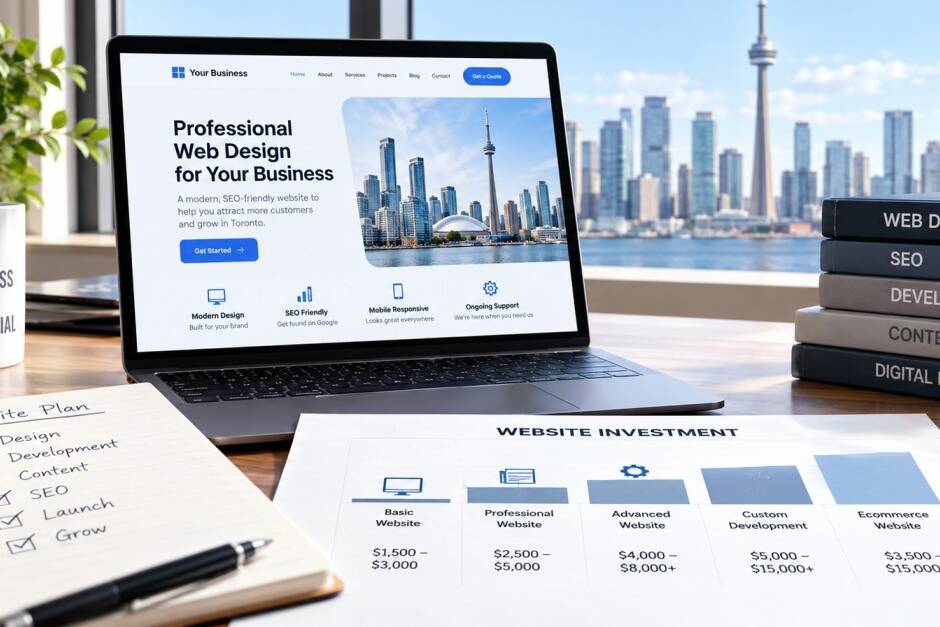
How Much Does a Small Business Website Cost in Toronto in 2026?
How much does a small business website cost in Toronto in 2026? Explore typical…

October 12, 2026
Does Your Business Website Actually Generate Leads?
Is your business website attracting visitors but failing to generate inquiries?…
October 5, 2026
How to Redesign Your Toronto Website Without Losing SEO
A new website should bring in more business, not less. Yet one of the most…
